As the health care industry transitions beyond the COVID-19 public health emergency era, Congress continues to demonstrate bipartisan support for expanding access to telehealth.
However, telehealth providers will invariably encounter certain legal and regulatory complexities as lawmakers work toward establishing a more permanent regulatory framework. At the same time, states are moving from broad expansion to refinement, focusing on reimbursement precision and licensure compacts.
Key Takeaways for Telehealth Providers and Organizations:
- Unstable Medicare rules make long-term planning difficult. Flexibilities can change with short notice, putting reimbursement, care models, and staffing decisions at risk for mental and behavioral health providers.
- Remote prescribing remains uncertain and complex. While telehealth prescribing is still allowed, permanent DEA rules are delayed. Providers face ongoing confusion about compliance, platform requirements, and state-by-state differences.
- Compliance risk is rising fast. Federal enforcement is expanding, with closer scrutiny of billing, documentation, and prescribing. One mistake can trigger audits, penalties, or legal exposure.
Since 2016, Epstein Becker Green has researched, compiled, and analyzed the state-specific regulatory requirements for professional mental/behavioral health practitioners and stakeholders offering telehealth-focused services. We are pleased to release our latest compilation of state telehealth laws, regulations, and policies within the mental and behavioral health practice disciplines.
While other state-focused telehealth surveys exist, this survey focuses solely on the remote delivery of behavioral health care services. It is vital to keep this important resource up to date as the legal and regulatory landscape continues to rapidly evolve.
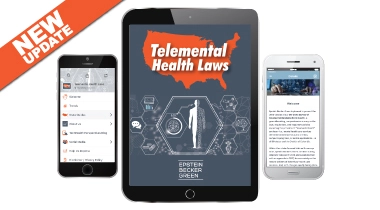
We are pleased to once again release our latest update to our Telemental Health Laws app, an extensive compilation of laws, policies, and other state guidance for practitioners supporting the mental/behavioral health practice disciplines.
The survey’s complete findings are available to download for free as an app for iPhone, iPad, and Android devices.
Read our full announcement, our executive summary, and see our introduction video below.
Please contact Audrey Davis or Avery Schumacher with questions.
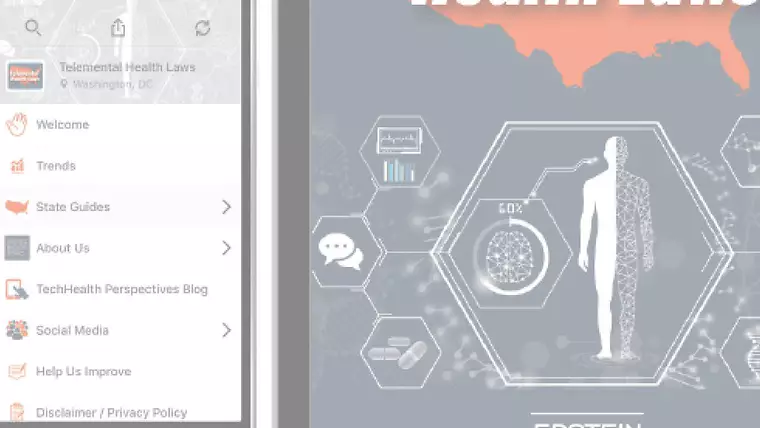
Download Epstein Becker Green’s Telemental Health Laws App


About Thought Leaders in Health Law
The Thought Leaders in Health Law® video series tracks the latest trends in multiple areas of the health care and life sciences industries, featuring attorneys and advisors from Epstein Becker Green and EBG Advisors. Part of the Epstein Becker Green Insights Network.
Email Notifications
The app’s editors and contributors are grateful to Epstein Becker Green 2025 Summer Associates who provided research and drafting support: Himani Gubbi, Julia Renfroe, Chloe Shumaker, and Sahar Tirmizi.